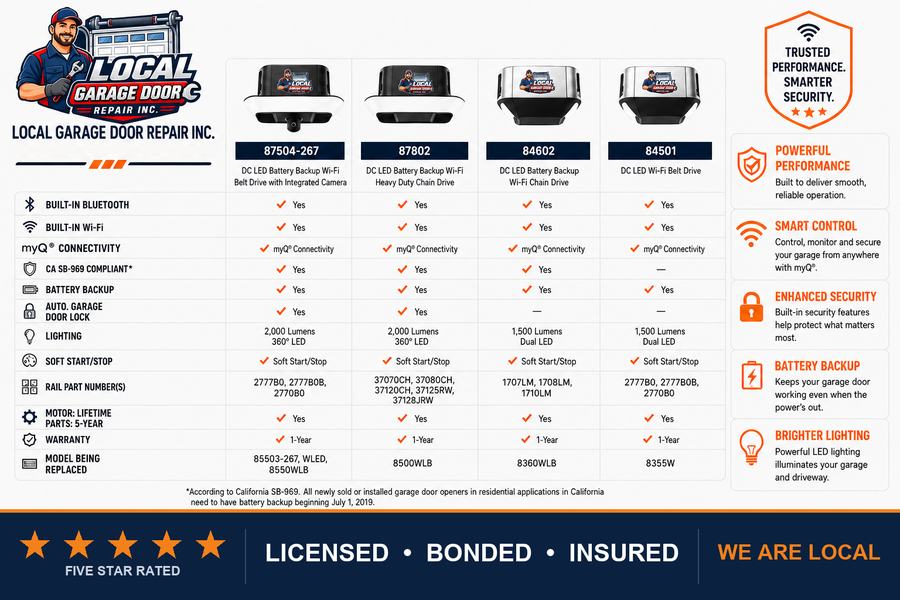
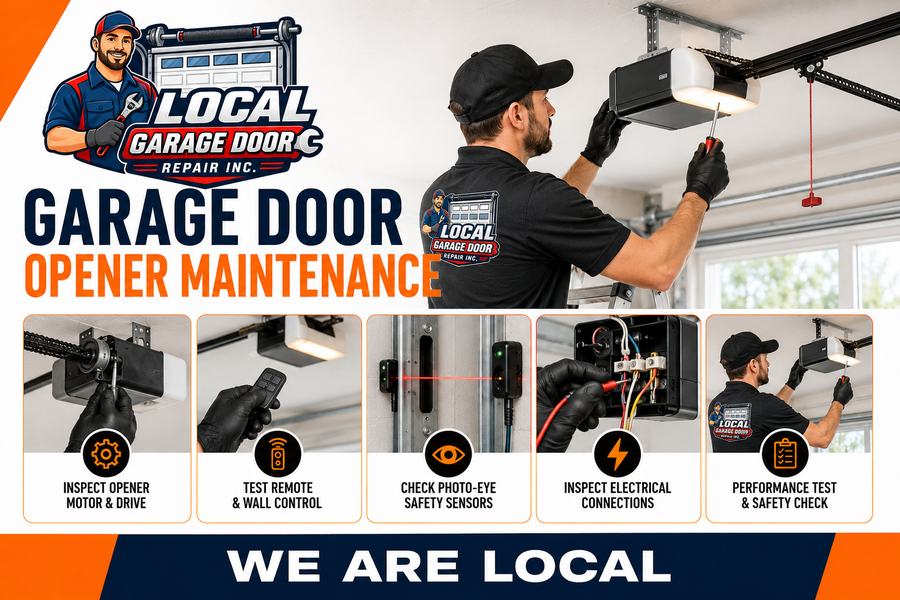
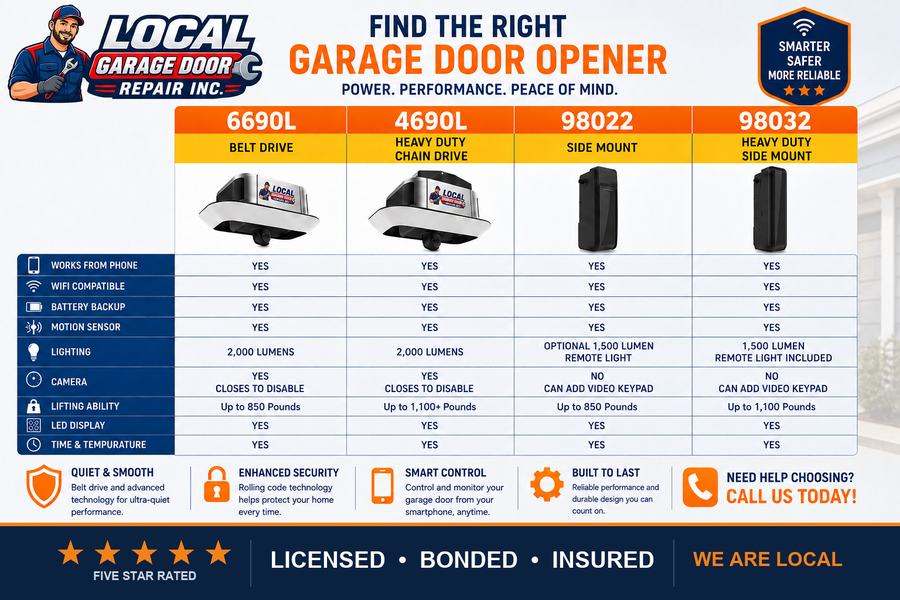
Technical inspection and component layout for Garage Door Opener Repair in West Hollywood, CA.
We keep chain, belt and direct-drive units on the van, along with rails, carriages, remotes and wall buttons, so an opener fault in West Hollywood is usually diagnosed and finished in one appointment.
Based in West Hollywood
Our headquarters are at 8265 W Sunset Blvd, Suite 100 in West Hollywood. When you call for Garage Door Opener Repair, we schedule same-day service, and the service vehicle is stocked with common replacement parts and spring sizes, so most jobs are finished in one visit.
Garage Door Openers: Complete Guide to Repair, Installation, Replacement, and Maintenance
What Is a Garage Door Opener?
A garage door opener is a motorized system designed to automatically open and close a garage door safely and efficiently. Garage door openers work together with garage door springs and tracks to provide smooth operation and reliable performance.
Modern garage door openers include advanced features such as Wi-Fi connectivity, smartphone control, battery backup systems, motion detection lighting, and enhanced security technology.
Garage door openers are commonly used in residential and commercial garage door systems to improve convenience, security, and accessibility.
How Garage Door Openers Work
Garage door openers use an electric motor connected to a rail and drive system to move the garage door along its tracks. The opener works with the garage door spring system, which helps balance the weight of the door.
Most garage door opener systems include:
Motor unit
Rail system
Trolley carriage
Remote controls
Wall-mounted control panel
Safety sensors
Emergency release cord
When the remote control or wall switch is activated, the opener moves the garage door safely and smoothly.
Types of Garage Door Openers
There are several types of garage door openers available for residential and commercial properties.
Chain Drive Garage Door Openers
Chain drive garage door openers use a metal chain to move the garage door along the track system.
Benefits of Chain Drive Openers
Affordable and cost-effective
Durable and reliable
Suitable for heavy garage doors
Widely available replacement parts
Disadvantages of Chain Drive Openers
Noisier operation
Requires regular maintenance
Produces more vibration
Chain drive openers are one of the most popular garage door opener systems for homeowners.
Belt Drive Garage Door Openers
Belt drive garage door openers use a reinforced rubber belt instead of a metal chain.
Benefits of Belt Drive Openers
Quiet operation
Smooth performance
Minimal vibration
Ideal for attached garages
Disadvantages of Belt Drive Openers
Higher upfront cost
Belt replacement may eventually be required
Belt drive garage door openers are ideal for homes where quiet operation is important.
Screw Drive Garage Door Openers
Screw drive garage door openers use a threaded steel rod to move the garage door.
Benefits of Screw Drive Openers
Fewer moving parts
Lower maintenance requirements
Reliable long-term performance
Disadvantages of Screw Drive Openers
Can become noisy over time
Performance may be affected by extreme temperatures
Direct Drive Garage Door Openers
Direct drive garage door openers use a stationary chain while the motor itself moves along the rail.
Benefits of Direct Drive Openers
Extremely quiet operation
Minimal maintenance
Smooth and reliable performance
Long lifespan
Disadvantages of Direct Drive Openers
Higher installation cost
Limited brand availability
Smart Garage Door Openers
Smart garage door openers allow homeowners to control and monitor their garage doors remotely using a smartphone app or smart home system.
Smart Garage Door Opener Features
Wi-Fi connectivity
Smartphone control
Remote garage access
Real-time notifications
Voice assistant compatibility
Automatic closing timers
Security monitoring
Smart garage door openers improve both convenience and home security.
Signs Your Garage Door Opener Needs Repair
Belt, chain, screw and direct-drive openers compared
Garage door openers can develop mechanical or electrical problems over time.
Common signs of garage door opener problems include:
Garage door will not open or close
Remote control stops working
Opener motor runs but the door does not move
Loud grinding or rattling noises
Slow garage door movement
Flashing opener lights
Garage door reverses unexpectedly
Wall switch becomes unresponsive
Ignoring these issues may lead to additional damage or complete opener failure.
Common Garage Door Opener Problems
Worn Internal Gears
Garage door opener gears can wear out over time, especially in older units.
Misaligned Safety Sensors
Safety sensors may become blocked or misaligned, preventing the garage door from closing properly.
Broken Drive Components
Chains, belts, or screw drive systems can loosen or wear down.
Electrical Issues
Wiring problems, damaged circuit boards, or power supply failures can affect opener performance.
Remote Control Malfunctions
Dead batteries, programming issues, or signal interference may stop remote controls from functioning properly.
Garage Door Opener Safety Features
Modern garage door openers include advanced safety systems designed to prevent accidents and improve security.
Photo Eye Safety Sensors
Safety sensors detect objects in the garage door’s path and automatically reverse the door if an obstruction is detected.
Auto-Reverse System
The auto-reverse feature stops and reverses the garage door if resistance is detected while closing.
Manual Emergency Release
The emergency release cord allows manual garage door operation during power outages or emergencies.
Rolling Code Technology
Rolling code systems generate a new security code after every use to help prevent unauthorized access.
Garage Door Opener Maintenance
Opener servicing: drive, rail, safety sensors and remotes
Routine maintenance helps extend the lifespan of a garage door opener and improves reliability.
Lubricate Moving Parts
Apply garage-door-specific lubricant to:
Chains
Rollers
Hinges
Bearings
Test Safety Sensors
Ensure garage door safety sensors are clean, aligned, and functioning correctly.
Tighten Hardware
Inspect and tighten loose brackets, bolts, and mounting hardware.
Check Garage Door Balance
An unbalanced garage door places excessive strain on the opener motor.
Replace Remote Batteries
Regular battery replacement helps maintain reliable remote control operation.
Garage Door Opener Installation
Opener models we install, service and carry parts for
Professional garage door opener installation ensures safe and proper setup.
Typical Garage Door Opener Installation Process
Remove the old garage door opener if necessary
Install mounting brackets and supports
Attach the rail system
Install the opener motor
Connect the drive mechanism
Install safety sensors
Program remotes and wall controls
Test operation and safety systems
Professional installation helps prevent safety issues and performance problems.
Garage Door Opener Lifespan
Most garage door openers last between 10 and 15 years depending on maintenance, usage, and opener quality.
Factors that affect opener lifespan include:
Frequency of garage door use
Door size and weight
Maintenance quality
Environmental conditions
Type of opener system
Regular inspections and maintenance can help maximize the lifespan of your garage door opener.
Garage Door Opener Repair and Installation Costs
Garage door opener repair and installation costs vary depending on the type of service and replacement parts required.
Starting Prices for Garage Door Opener Services
Garage door opener repair starting at $245
Garage door opener installation starting at $245
Garage door opener replacement starting at $245
Remote control programming starting at $25
Safety sensor repair
Smart garage door opener upgrades starting at $245
Emergency garage door opener service starting at $245
Final pricing may vary depending on the garage door opener model, required parts, labor, and repair complexity.
Choosing the Right Garage Door Opener
Selecting the right garage door opener depends on several important factors.
Important Features to Consider
Garage door size and weight
Noise level preferences
Smart technology compatibility
Horsepower requirements
Security features
Battery backup systems
Budget and long-term maintenance
Choosing the correct garage door opener helps improve safety, convenience, and long-term reliability.
When to Call a Professional Garage Door Technician
Professional garage door opener service is recommended if:
The opener motor fails
Safety sensors stop working
The garage door reverses unexpectedly
Loud noises develop during operation
Electrical problems occur
The opener struggles to lift the garage door
Installation or replacement is needed
Garage door professionals have the tools and experience needed to safely diagnose and repair opener problems.
Conclusion
Garage door openers provide safe, convenient, and reliable access to residential and commercial garages. From chain drive systems to advanced smart garage door openers, there are many options available to fit different needs and budgets.
Routine maintenance, inspections, and professional garage door opener repairs can help extend the life of your opener and ensure smooth garage door operation for years to come.
Standard Schedule of Rates: Garage Door Opener Repair
* All work is provided with an exact upfront estimate before work begins. No hidden call-out or quote fees.
Starts at
Garage door opener
$245
Opener rail
$145
Carriage
$125
Battery backup
$145
Remote / clicker
$25
Wall button
$45
Coming out to you and quoting the job is free. The other figures are starting prices — the final cost depends on the parts and the job, and you get the exact figure before any work begins.
Frequently Asked Questions
Straight answers, from the people who do the work
How much does a new garage door opener cost in Los Angeles?
A garage door opener from Local Garage Door Repair Inc. starts at $245. The final price depends on the drive type (chain, belt, screw, direct, or smart Wi-Fi), the horsepower your door's size and weight require, and extras like battery backup, which starts at $145. The estimate is free and the exact price is set before installation begins.
My opener runs but the door doesn't move — what's wrong?
That is usually a stripped trolley carriage or worn internal gears — the motor spins but nothing grips the door. An opener carriage starts at $125 and an opener rail starts at $145 if the rail itself is damaged. It can also mean the door was disconnected at the emergency release, which is a free fix you can check first.
Which type of garage door opener is best?
Chain drives are the affordable workhorse, belt drives are the quiet choice for a garage attached to living space, screw drives have fewer moving parts, and direct drives are the quietest of all. Smart Wi-Fi openers add phone control, real-time alerts, and voice-assistant support on top of any of these.
How long does a garage door opener last?
Most openers last 10 to 15 years. Heavy daily use, a heavy or unbalanced door, and skipped maintenance shorten that; a balanced door and periodic lubrication stretch it.
Should I repair my opener or replace it?
Repair usually wins while the unit is younger and the failed part is small — a remote starts at $25, a wall button at $45, a carriage at $125. Replacement makes more sense when the motor itself fails on an older unit, or when you want modern safety sensors, rolling-code security, or smartphone control that an old opener cannot do.
Why won't my remote open the garage door?
Nine times out of ten it is a dead battery or lost programming, and reprogramming is quick. If a replacement is needed, remotes start at $25. If no remote or wall button works, the problem is the opener or its power supply rather than the remote — worth a free diagnostic visit.
How much does garage door opener cost?
Garage door opener from Local Garage Door Repair Inc. in West Hollywood starts at $245. This covers opener repair and replacement. The exact price depends on the opener type (chain, belt, or screw drive) and whether the motor, gears, or circuit board is the problem. This is a starting price — the exact total is confirmed on site before any work begins. Call (310) 988-1325✦✦✦ for a free estimate.
How much does opener battery backup cost?
Opener battery backup from Local Garage Door Repair Inc. in West Hollywood starts at $145. A battery backup keeps the opener working during a power outage. This is a starting price — the exact total is confirmed on site before any work begins. Call (310) 988-1325✦✦✦ for a free estimate.
How much does opener carriage cost?
Opener carriage from Local Garage Door Repair Inc. in West Hollywood starts at $125. The carriage is the part of the opener that rides the rail and pulls the door open. This is a starting price — the exact total is confirmed on site before any work begins. Call (310) 988-1325✦✦✦ for a free estimate.
How much does opener rail cost?
Opener rail from Local Garage Door Repair Inc. in West Hollywood starts at $145. The rail guides the carriage from the opener motor to the door. This is a starting price — the exact total is confirmed on site before any work begins. Call (310) 988-1325✦✦✦ for a free estimate.
How much does remote control / clicker cost?
Remote control / clicker from Local Garage Door Repair Inc. in West Hollywood starts at $25. This covers a replacement remote programmed to your existing opener. This is a starting price — the exact total is confirmed on site before any work begins. Call (310) 988-1325✦✦✦ for a free estimate.
How much does wall button cost?
Wall button from Local Garage Door Repair Inc. in West Hollywood starts at $45. The wall button is the manual open/close switch inside the garage. This is a starting price — the exact total is confirmed on site before any work begins. Call (310) 988-1325✦✦✦ for a free estimate.
Do you offer same-day garage door repair?
Yes. Local Garage Door Repair Inc. offers same-day service seven days a week, 6 AM to 11 PM, West Hollywood and the surrounding Los Angeles area. Emergency call-out is available outside those hours. Call (310) 988-1325✦✦✦ to get on the schedule.
Is the estimate free?
Yes. The service call and estimate are FREE — a technician comes out, diagnoses the problem, and gives you the exact price before any work starts. There is no charge just to find out what's wrong.
Why won't my garage door opener respond to the remote?
Most often it's just a dead battery. After replacing it, the remote usually needs to be re-synced to the opener — there is a "learn" button on the back of the opener unit for this. If it still is not responding after a fresh battery and re-sync, the receiver itself may have an issue. It is also worth checking that nothing is blocking your safety sensors, since a blocked sensor can affect how the opener responds.
My garage door opener light is blinking — what does that mean?
A blinking light is the opener's way of flagging a problem — usually either the safety sensors are misaligned or blocked, or there is a broken part somewhere on the door (a spring, roller, or bracket) that the opener has detected resistance from.
Why does my garage door open but not close, or reverse right before closing?
This is almost always a sensor issue — either the sensors are blocked or out of alignment. Check that nothing is in the sensors' path first; call (310) 988-1325✦✦✦ if that doesn't solve it.
How do I reprogram my garage door remote?
Press the "learn" button on the back of the opener unit, then press the button on the remote you want to program — this syncs the remote's rolling code to the receiver. The remote and receiver need to match on that rolling code for the system to work.
Why does my garage door opener make noise but the door does not move?
This usually means the opener has become disconnected from the door — sometimes because the emergency release cord was pulled. It can also mean something has broken inside the opener itself, or a part on the door needs repair.
What's the difference between chain, belt, and screw-drive openers?
Chain-drive openers are strong and reliable, similar to a bicycle chain, but a bit noisier. Belt-drive openers are quiet and smooth — like a timing belt — and hold up well, though they can eventually wear out after many years of use. Screw-drive openers use a long spinning rod to pull the door up; we do not recommend them as strongly, since the mechanism tends to wear down faster with extended use. All three get the job done, but belt and chain drives are our preferred recommendations.
How do I manually disconnect my garage door opener during a power outage?
There is a red release cord near the opener, close to the door. Pull it down, and the door can then be opened by hand. If the door is in good working condition, it should open smoothly. If it is unusually heavy or moves too fast, that is a sign the springs need adjustment or replacement — do not force it, call (310) 988-1325✦✦✦.
Why will my garage door not close?
The most common cause is the safety sensors — check that they are aligned and that each one shows a solid light (one sensor shows red, the other green; both need to be lit for the door to close). If the lights are correct but the door still will not close, check for anything blocking the door's path. If neither of those solves it, the door itself likely has an issue and needs a technician. Do not force the door — forcing it when there is a problem with the cables, springs, opener, or misaligned tracks can cause serious additional damage. Call (310) 988-1325✦✦✦.
Can I try to fix my garage door myself?
For minor things, you are welcome to try. But we do not recommend it for anything involving the springs. Garage door springs carry heavy tension and can be genuinely dangerous, and a mistake can cause the door to fall — which can lead to serious injury or far more damage than the original problem. This is one repair that is always best left to a professional. Call (310) 988-1325✦✦✦.
Why shouldn't I try to fix a garage door spring myself?
Springs are under very high tension, and replacing them safely takes real training — our technicians train for months before they are trusted to handle a spring replacement on their own. One mistake can cause the door to collapse and lead to serious injury. It is not a job to take on yourself.
Is it safe to let kids or pets near a garage door while it is moving?
No. A moving garage door is genuinely dangerous, and no one — kids or pets included — should be near it or touching it while it is opening or closing.
What should I do if my garage door won't stop closing on something?
Press the wall button or the remote again — this should reverse the door. If it does not reverse, stop trying to force it and call (310) 988-1325✦✦✦ right away.
Does my garage door or opener come with a warranty?
New doors and openers carry a manufacturer's warranty, typically 1 to 5 years depending on the brand you choose. We also offer extended warranty coverage — including a lifetime option — along with free maintenance and free service calls through our membership program. Call (310) 988-1325✦✦✦ for details.
If my opener is still under the manufacturer's warranty, what do you do?
We contact the manufacturer on your behalf to help process the warranty claim, and we handle the installation for you.
Need Immediate Garage Door Opener Repair?
Schedule a local technician online in under 60 seconds or speak with direct emergency dispatch now.
You will receive a confirmation text message shortly with a direct link to confirm or update your appointment time.
Our technician will phone you approximately 20 minutes before setting off, ensuring you don't have to wait around at the door.
Upon arrival, he will inspect the door and provide the exact final price before any work begins.
Local to West Hollywood
We work across West Hollywood every day — from the hills
above Sunset down to Fairfax and Santa Monica Boulevard. If you are new to the
neighborhood, or just curious about it, here is the city guide:
Hi! You're through to Local Garage Door Repair Inc. Ask me anything about Garage Door Opener Repair - or just tell me what the door is doing and I'll get a technician out to you.